
Why does your page rank in Google Search, yet a competitor’s website gets mentioned in an AI-generated answer?
Google’s AI may explore related searches to gather information before generating an answer.
This process is known as query fan-out. Instead of relying on one search alone, an AI search experience can explore related searches to gather information from different sources.
For businesses, this changes how they should think about content. Repeating a target keyword isn’t enough. A page needs to answer the reader’s question clearly, cover relevant details and offer information worth reading.
What Is Query Fan-Out in Google AI Mode?
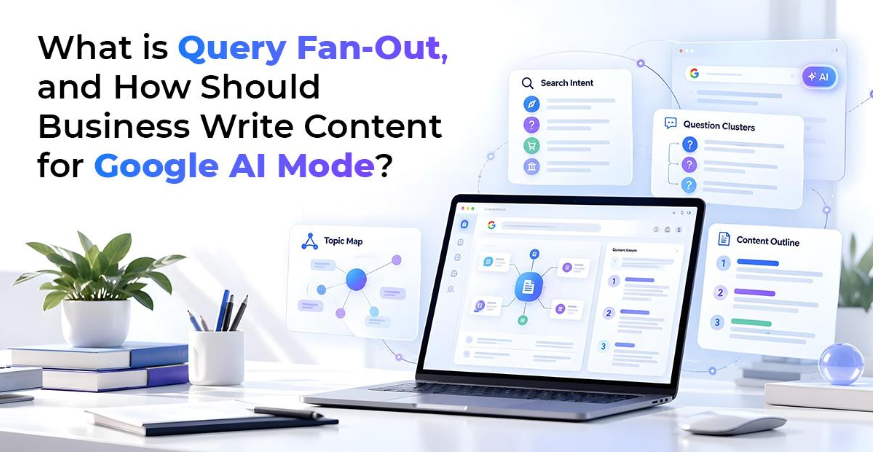
Query fan-out is the process of expanding a user’s question into multiple related searches to gather information from different sources. Google’s AI Mode can use this approach to explore different parts of a question before generating a response.
Imagine a business owner asking, “How much does it cost to develop a business website?” The original question is about price, but a useful answer may also require information about development timelines, hosting, website platforms, security and ongoing maintenance.
Related searches can help the system explore these areas. It may then draw on relevant pages when preparing its response.
For businesses, the practical point is simple: understand what a reader needs to know about a subject, rather than focusing only on the wording of the original search. It is a search process, not a content format that writers need to copy.
How Does Fan-Out Change What Ranking Means for a Business Page?
A page may be relevant to one part of a broader question, even when it doesn’t cover the entire topic. Google says AI Mode and AI Overviews may use query fan-out to find supporting pages across related searches.
For a business, this means a page should answer its main query well and provide useful information on the related questions that naturally belong with it. A page about website development, for example, might explain pricing factors and timelines, while linking to separate pages about hosting or security when readers need more detail.
Traditional search rankings are still important because a page must be indexed and eligible to appear in Google Search to qualify as a supporting link in these AI features. But a good ranking does not guarantee that Google will include the page in an AI response.
Does Your Content Answer the Questions Around a Topic, Not Just One Keyword?
Useful content addresses the reader’s main question and the related concerns they are likely to have. It should offer accurate details, original insight and examples that are relevant to the audience, rather than repeat the same keyword across several paragraphs.
Start by listing the questions a reader might ask before making a decision. For a small business researching website options, these could include cost, maintenance, mobile usability and the difference between a template and a custom solution. A business planning its digital marketing strategies for small business can use the same approach by answering practical questions about its audience, budget and available channels.
Keep closely related questions on one page when they form a useful explanation. Create separate pages when a subject needs more depth, then link them clearly. Avoid publishing thin pages for every possible search variation. Google’s guidance emphasises valuable, original content, not pages created mainly to influence AI results.
Which Technical Basics Still Decide Whether Your Pages Can Be Used?
Your content must be accessible to Google Search before it can appear as a supporting link in AI Mode or AI Overviews. Google says there are no additional technical requirements for these AI features beyond the existing requirements for Search.
Start with the basics. Check that important pages can be crawled and indexed, and link related pages using descriptive anchor text. Add useful images or videos when they explain something better than text alone. If you use structured data, make sure it matches what visitors can actually see on the page.
Local businesses should also keep their Google Business Profile details current, including opening hours and contact information. Businesses looking for local SEO services in Mumbai should pay particular attention to the accuracy of their local business information.
Verify the website in Google Search Console to monitor indexing and search performance.
These checks won’t guarantee an AI mention, but they can reveal problems that prevent your pages from appearing in Search.
What Should Businesses Stop Doing?
Businesses should stop treating AI search as a shortcut around established search practices. Google says its existing SEO guidance remains relevant to AI features, so there is no need to chase every new tactic promoted online.
A few common approaches deserve caution:
- Treating llms.txt as a Google ranking lever: Google does not list it as a requirement for AI Mode or AI Overviews.
- Breaking every paragraph into artificial chunks: Organise content for readers, not around a supposed AI formatting rule.
- Adding special schema for AI: There is no special AI schema requirement. Use structured data where appropriate and keep it consistent with visible content.
- Buying brand mentions or manufacturing backlinks: Manipulative link practices can violate Google’s spam policies.
- Promising AI citations: No agency can guarantee that a particular page will appear in an AI-generated answer.
The better use of time is to improve content quality, technical accessibility and the usefulness of the information already on your website.
How Can You Check Your Progress?
Google Search Console can show how your website performs in Search, but it does not provide a simple, guaranteed measure of future AI visibility. Google’s documentation says traffic from AI features is included in the overall search traffic data, so interpret the available metrics carefully.
Review impressions, clicks, indexing status and the search queries bringing visitors to important pages. In Google Analytics 4 (GA4), check whether organic visitors submit enquiries, make purchases or complete other useful actions.
You can also test a small set of relevant questions in AI Mode periodically and record which sources appear. Treat these checks as observations, not a reliable forecast. Results can vary, and no third-party tool can promise accurate predictions of every future AI mention.
Frequently Asked Questions
Is query fan-out something I can optimise for directly?
There is no switch or special tag that makes a page appear in query fan-out results. Focus on useful content, clear organisation and sound technical SEO. Answer related questions where they add value, rather than creating pages for every possible query variation.
Do I need a special schema or an llms.txt file?
No special markup or AI-specific file is required for Google AI Mode or AI Overviews. Structured data remains useful for supported search features when it accurately describes visible page content.
Is AEO or GEO different from SEO?
AEO means answer engine optimisation, while GEO means generative engine optimisation. Both terms describe approaches to improving visibility in AI-powered search experiences. For Google’s AI features, the underlying work still relies on established SEO practices and useful content.
Will ranking on page one guarantee an AI mention?
No. A strong traditional search ranking can make a page eligible for consideration, but it does not guarantee inclusion in an AI-generated response. Google selects supporting links according to its systems and the needs of the particular query.